
Bwindi Impenetrable National Park is home to 13 primate species, making it one of the most primate-rich forests in East Africa.
The park supports a remarkable variety of wildlife, including mountain gorillas, chimpanzees, several species of monkeys, and nocturnal primates. It is also one of the few places in Africa where both gorillas and chimpanzees naturally coexist in the same forest.
There are eight species of diurnal monkeys, three nocturnal primates (two galagos and one potto), and several species that are especially common around the Buhoma area, such as L’Hoest’s monkey, black-and-white colobus, red-tailed monkey, and blue monkey.
The park also supports important predators like the crowned eagle, which plays a key ecological role by preying on monkeys in the forest canopy. The best places to observe primates are forest-edge trails, canopy gaps, and areas near Buhoma where wildlife activity is especially high.
A Primate Paradise
Bwindi’s exceptional primate diversity is the result of its long ecological history, wide altitude range, and complex forest structure. The forest survived ancient climatic changes as a refugium, allowing many primate species to persist while disappearing elsewhere. Today, the park provides a home where 13 primate species live side by side, each occupying different layers of the forest from the ground to the highest canopy.
For visitors, primate encounters are highly likely, especially near Buhoma where forest meets farmland. Even short walks along forest trails often reveal several monkey species moving through the trees or feeding at the forest edge.
The Great Apes
Mountain Gorilla
Gorilla beringei beringei
The mountain gorilla is Bwindi’s flagship species and one of the main reasons the park is world famous. Bwindi supports roughly 459 individuals living in multiple family groups, several of which are habituated for tourism. Adult males, known as silverbacks, are powerful leaders that can weigh up to 200 kg. They spend most of their time on the ground, feeding on leaves, stems, and shoots, and are strictly vegetarian.
Mountain gorillas exist only in two populations in the world—Bwindi and the Virunga Massif—and cannot survive in captivity. This makes every encounter with them a rare and special wilderness experience.
Chimpanzee
Pan troglodytes schweinfurthii
Bwindi is also home to several hundred chimpanzees of the eastern subspecies. Unlike gorillas, chimpanzees are highly arboreal and spend much of their time in the forest canopy. They feed mainly on fruits, leaves, and occasionally hunt smaller monkeys.
Chimpanzees in Bwindi are not fully habituated for tourism in most areas, so they are more often heard than seen. Their loud pant-hoot calls often echo through the forest, giving visitors a sense of their presence even when they remain hidden.
Diurnal Monkeys
Bwindi is home to six species of diurnal monkeys, varying from frequently seen and easily noticed to those that are far more scarce and difficult to spot. While most of these monkeys live in the trees and spend much of their time in the forest canopy, a few also come down to the ground on a regular basis.
L’Hoest’s monkey
Allochrocebus lhoesti
L’Hoest’s monkey is an Albertine Rift endemic primate and among the most commonly observed monkeys in Bwindi forest.
It is easily recognized by its dark body contrasted with a striking white chest “bib.” Unlike many guenons, this species spends much of its time on the ground, showing a more terrestrial lifestyle.
They typically live in small social groups of about 5 to 15 individuals, usually organized around a single adult male. Sightings often occur along forest edges within Bwindi Impenetrable National Park, where they forage for a varied diet that includes fallen fruits, mushrooms, and tender herbaceous plants. According to conservation assessments, the species is classified as Vulnerable on the IUCN Red List.
Black-and-white colobus
Colobus guereza
Black-and-white colobus is widely regarded as one of the most visually striking primates in Bwindi Impenetrable National Park. Its glossy black coat is sharply contrasted by a long white mantle running along its sides, complemented by a flowing white tail that stands out as it moves through the canopy.
This species is highly specialized for a leaf-based diet, with a complex, multi-chambered stomach that allows it to ferment cellulose efficiently—an evolutionary adaptation similar to that of grazing mammals. Social groups usually consist of about 3 to 15 individuals, and they are most often found high in the forest canopy rather than on the ground.
Red-tailed monkey
Cercopithecus ascanius
Red-tailed monkey is one of the most frequently encountered primates in Bwindi Impenetrable National Park, occurring across a wide range of elevations and forest types.
It is easily identified by its chestnut-red tail and a distinctive white nose patch that often appears heart-shaped. This species is highly social and commonly forms mixed foraging groups with blue monkeys, increasing vigilance and feeding efficiency.
Their diet is broad and adaptable, including fruits, insects, flowers, and young leaves. Social groups typically range from 10 to 35 individuals, moving noisily through the mid-level canopy as they search for food throughout the forest.
Blue monkey
Cercopithecus mitis
Blue monkey—also known as Sykes’ monkey—is a primate more grey-brown than truly blue, despite its common name. It typically has a dark face and may show a faint pale “diadem” of fur across the forehead, which helps with identification in the forest.
In Bwindi Impenetrable National Park, this species occupies the mid-canopy and lower forest layers, where it moves and feeds in relatively active social groups. Troops usually consist of 10 to 40 individuals and are organized around a single adult male.
Blue monkeys primarily feed on fruits and leaves, and they are well known for frequently forming mixed-species associations with red-tailed monkeys, a behavior that improves foraging success and predator awareness.
Grey-cheeked mangabey
Lophocebus albigena
Grey-cheeked mangabey is a large, dark-coated primate distinguished by its long, flowing shoulder mantle and robust build. It is one of the more powerful-jawed frugivores in the forest, capable of breaking open tough seeds and hard nuts that many other monkeys cannot exploit.
Within Bwindi Impenetrable National Park, this species is typically encountered in relatively large and vocal groups of about 10 to 30 individuals. Their communication is notable for deep, resonant “whoop-gobble” calls that can travel long distances through dense forest.
Compared to other primates in the area, grey-cheeked mangabeys are seen less frequently, making any sighting particularly memorable for visitors.
Red colobus
Piliocolobus tephrosceles
Red colobus is among Africa’s most threatened primates, classified as Endangered on the IUCN Red List. In Bwindi Impenetrable National Park, it is mainly restricted to the southern forest sectors of Rushaga and Nkuringo while seldom seen in the north.
This species is a specialized leaf-eater, relying on a fermentative digestive system similar to other colobus monkeys to break down cellulose-rich plant material. Socially, red colobus live in relatively large groups that can number up to around 80 individuals, making them one of the more gregarious primates in the forest.
They are identifiable by their reddish-brown crown and lighter underparts, which set them apart from other monkey species in Bwindi’s primate community.
Olive baboon
Papio anubis
Olive baboon is the largest monkey species associated with Bwindi Impenetrable National Park, with adult males capable of weighing over 25 kg. Unlike most other primates in the area, baboons are typically found along forest edges and in surrounding farmland rather than deep within dense forest.
They are highly intelligent, adaptable omnivores with a broad diet and strong problem-solving abilities, which can sometimes bring them into conflict with agriculture as they forage on cultivated crops. Their large canine teeth and complex troop structure make them physically formidable, although they usually avoid direct confrontation with humans.
Around all areas of bwindi, olive baboons are most often seen moving between forest margins and nearby human-modified landscapes in organized groups.
Vervet monkey
Chlorocebus pygerythrus
Vervet monkey is a highly adaptable primate typically associated with savanna and woodland habitats rather than dense rainforest. In the context of Bwindi Impenetrable National Park, it is mainly found along the forest edge and in nearby settlements rather than deep inside the forest interior.
These monkeys are omnivorous, social, and highly opportunistic, which allows them to thrive in human-modified environments. Around the park, troops are often habituated to people and may frequently be seen near lodges, roads, and cultivated areas where food is easily accessible.
Their flexibility in diet and behavior makes them one of the more visible primates in peripheral areas, even though they are not a core forest-dwelling species within Bwindi’s dense interior.
Nocturnal Primates
Bwindi is also home to three species of nocturnal primates, all belonging to the infraorder Lorisiformes. These animals are rarely encountered unless on a guided night walk with an experienced tracker, as they are highly secretive and active after dark within Bwindi Impenetrable National Park.
Together, these nocturnal primates represent a small but important part of the forest’s biodiversity, remaining largely hidden during the day and only revealing themselves under careful nighttime observation.
Demidoff’s Galago
Galagoides demidovii
Demidoff’s Galago is one of the smallest primates on Earth, typically weighing only about 60–100 grams. Despite its tiny size, it has disproportionately large eyes adapted for night vision, giving it the characteristic appearance of a classic bushbaby.
In Bwindi Impenetrable National Park, this nocturnal primate occupies the lower canopy and dense undergrowth, where it moves quickly and quietly in search of food. Its diet mainly consists of insects and tree gum, which it forages using agile, precise movements in the dark.
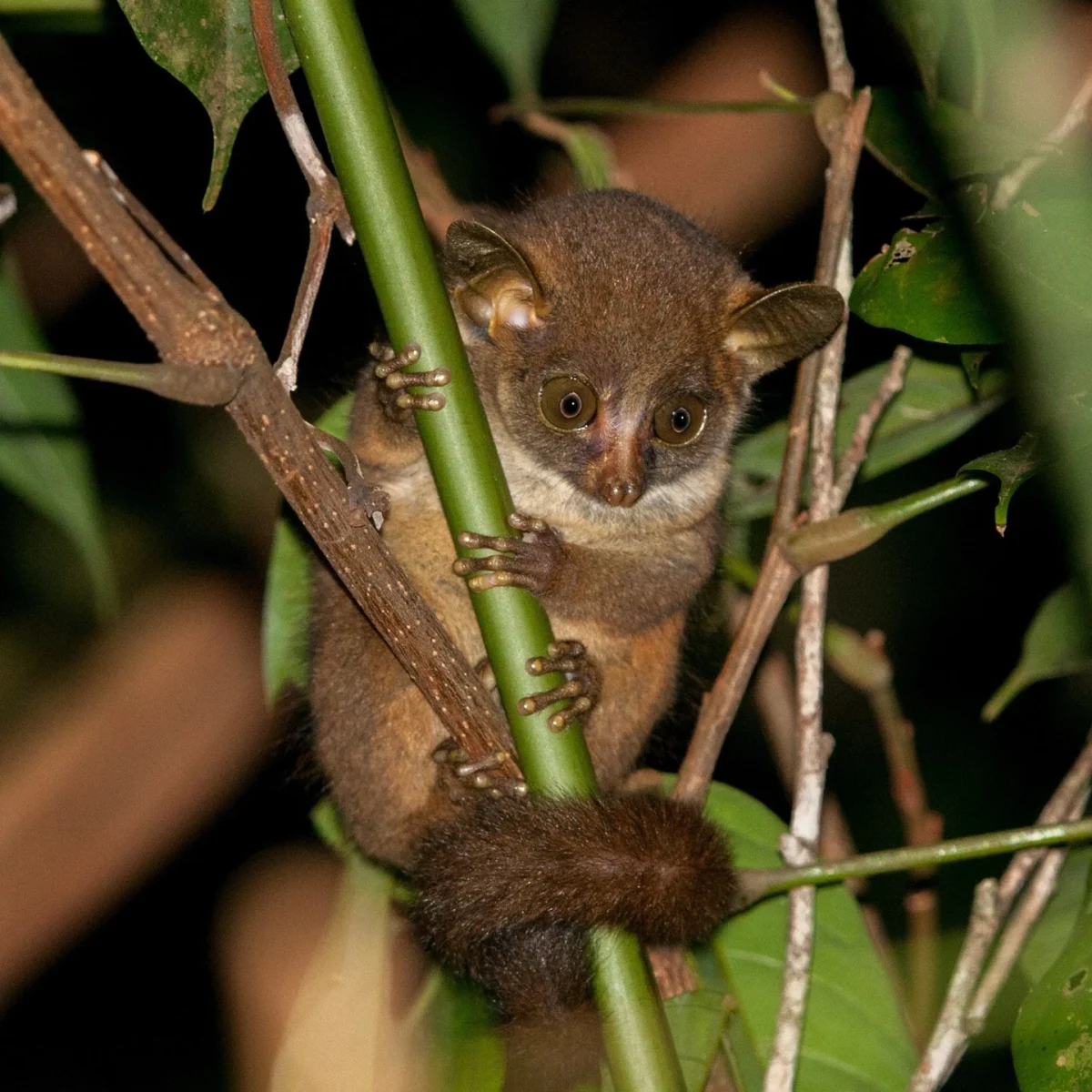
Although rarely seen due to its elusive behavior and nocturnal activity, its presence is often revealed by distinctive high-pitched calls that can be heard throughout the forest at night, even if the animal itself remains hidden from view.
Thomas’s galago
Galagoides thomasi
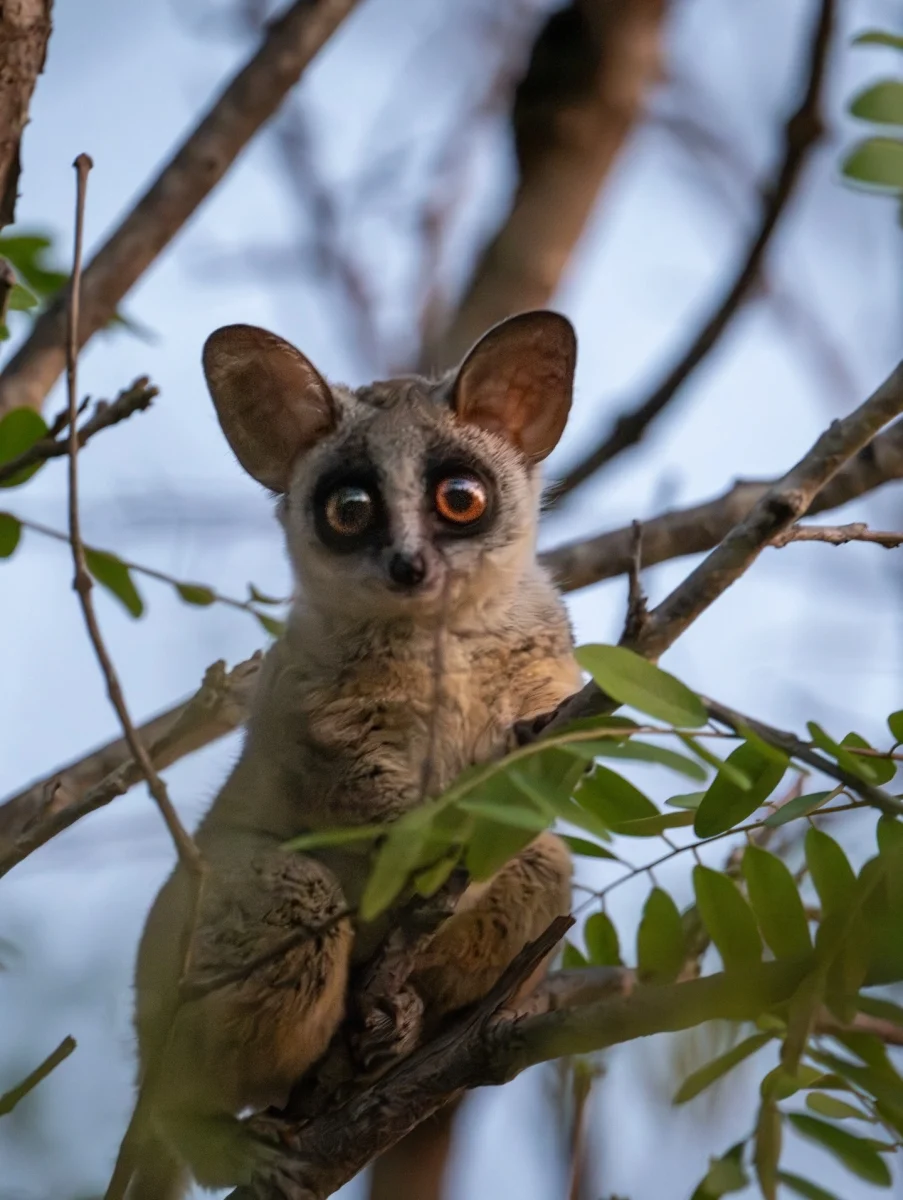
Thomas’s galago is a small nocturnal primate, slightly larger than Demidoff’s galago, and one of the most recognizable night-active species in Bwindi Impenetrable National Park thanks to its loud, piercing calls.
It typically inhabits the lower to mid-level canopy, where it moves through vegetation while foraging. Its diet includes insects, fruits, and tree gum, reflecting a flexible feeding strategy suited to forest life after dark.
Adapted to nocturnal conditions, it has large eyes for enhanced night vision and prominent ears that help it detect the movement of insect prey by sound. Around areas such as Buhoma, its vocalizations are often heard at night even when the animal itself remains hidden within the canopy.
Potto
Perodicticus potto
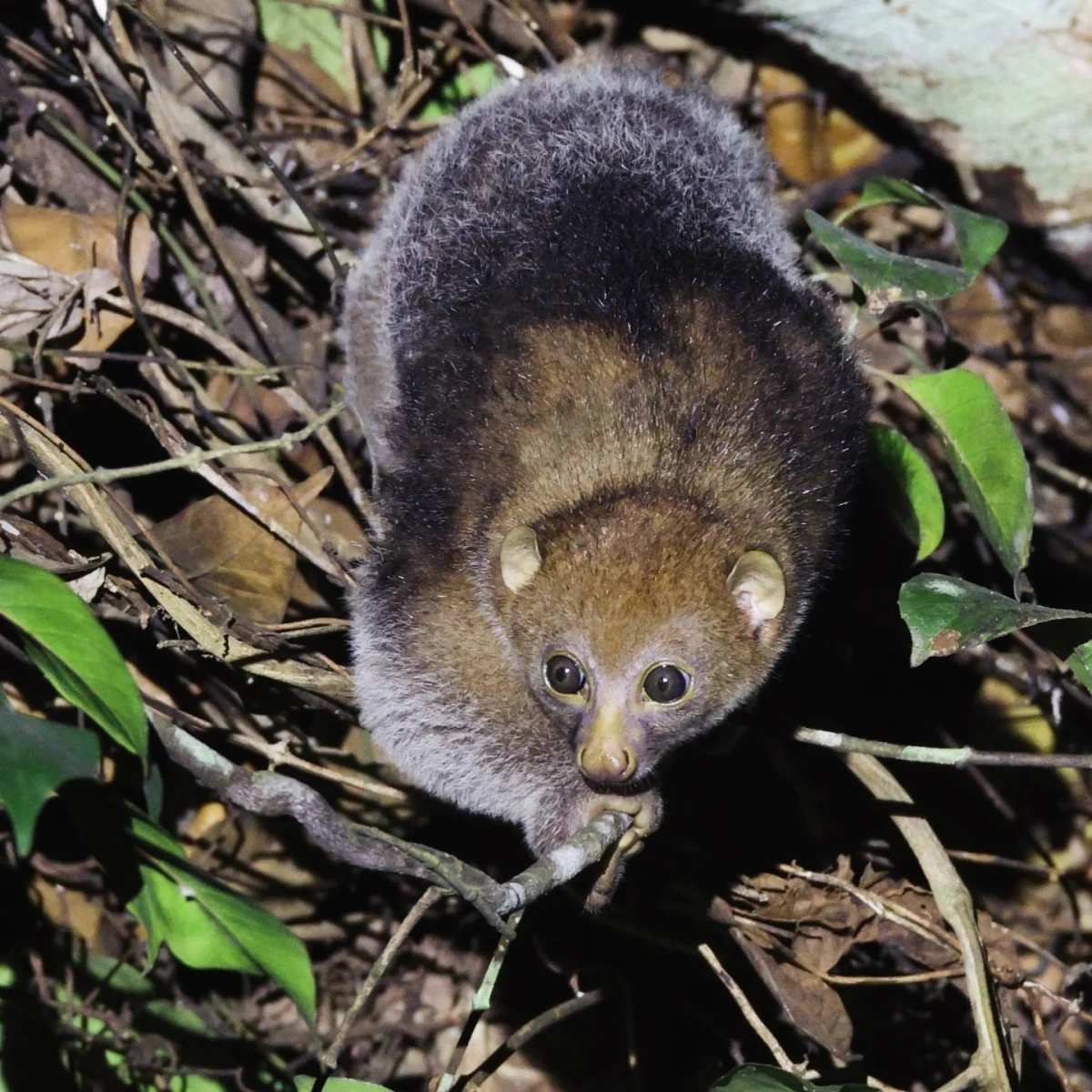
Potto is a slow-moving, highly secretive nocturnal primate found in Bwindi Impenetrable National Park. It moves with a deliberate, hand-over-hand climbing style through the canopy, relying on stealth rather than speed.
This species has several unusual anatomical adaptations, including reduced (vestigial) index fingers, a reinforced skull, and prominent bony projections on the neck vertebrae that are believed to function as a defensive feature against predators.
Primates of Bwindi Forest - Ecological Relationship
Bwindi’s primates are tightly woven into a complex ecological network that helps shape the structure and regeneration of the forest itself.
Frugivorous species such as mangabeys, red-tailed monkeys, and chimpanzees act as key seed dispersers. By consuming fruit and later depositing viable seeds in new locations, they enhance forest regeneration. In many cases, seeds that pass through a primate’s digestive system germinate more effectively than those that simply drop beneath the parent tree, giving these animals an essential role in maintaining plant diversity within Bwindi Impenetrable National Park.
Among the diurnal monkeys, mixed-species groupings are strongly influenced by predation risk. The crowned eagle (Stephanoaetus coronatus) is the main aerial predator of Bwindi’s primates and is capable of taking animals weighing up to around 20 kg. By traveling together in mixed-species associations, monkeys increase vigilance—more individuals scanning the canopy reduces the chance of surprise attacks.
At a larger scale, gorillas function as ecosystem engineers. Their feeding behavior opens gaps in the understory, allowing sunlight to reach the forest floor and encouraging pioneer plant growth. Their daily nesting habits create temporary microhabitats for insects and small vertebrates, while their dung distributes both nutrients and seeds across their range.
Together, these interactions illustrate how Bwindi’s forest is not just inhabited by primates, but actively shaped by them, forming a dynamic system of mutual ecological dependence.