
The Legend of Nyinamukari: The Tragic Story behind the Name Bwindi Impenetrable Forest, Uganda
June 24, 2026
Safety in Bwindi: What to Know
August 17, 2026New Monkey species in DR.Congo -The “Orange-Lipped” Mystery: The Discovery of Colobus congoensis
For centuries, the rainforests of the Democratic Republic of Congo have been described as one of Earth’s greatest biological treasure chests. Vast, remote, and largely unexplored, the Congo Basin continues to surprise scientists with discoveries that reshape our understanding of wildlife evolution. While many people assume that all large mammals have already been identified, nature occasionally reminds us that countless mysteries still remain hidden beneath the dense rainforest canopy.
In one of the most exciting zoological discoveries of the 21st century, scientists have officially described a previously unknown monkey species named Colobus congoensis, commonly known as the Likweli monkey. The New Monkey species in DR.Congo discovery, published in PLOS One, represents one of the few occasions in modern history that a completely new African primate has been recognized through comprehensive scientific research.
Beyond its striking appearance, the Likweli tells a much larger story—one of evolution, conservation, and the importance of protecting one of the planet’s last great wildernesses.
Unfortunately, the encounter was brief.
Researchers managed to capture only a single blurry photograph before the mysterious primates disappeared into the towering rainforest canopy. Without sufficient evidence, the unusual monkey remained little more than an intriguing mystery.
For the next decade, scientists searched repeatedly through one of Africa’s least explored forests, but sightings remained incredibly rare.
Then, in 2018, another encounter changed everything.
The second observation confirmed that the mysterious monkey truly existed, prompting an international research collaboration led by scientists from the Lukuru Wildlife Research Foundation, Florida Atlantic University, and conservation authorities in the Democratic Republic of Congo.
Over the following four years, researchers undertook an intensive field study involving hundreds of hours in the forest. Rather than relying on appearance alone, they collected multiple forms of evidence, including detailed behavioral observations, vocal recordings, physical measurements, and DNA samples.
Meet the Likweli Monkey - New Monkey species in DR.Congo
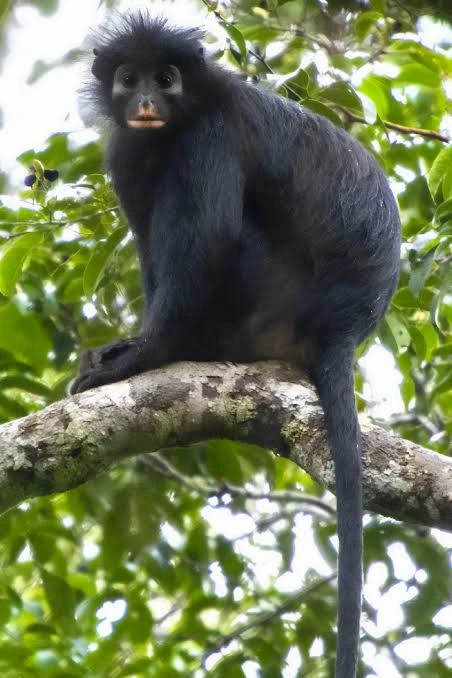
Scientifically named Colobus congoensis, the New Monkey species in DR.Congo derives its common name from the Likweli region where it was first documented.
Among local communities it is also called Kasaba Nkoni, a name translating roughly to “the branch shaker,” reflecting its energetic movement through the forest canopy.
Unlike many other black-and-white colobus monkeys, the Likweli possesses several remarkable features that immediately distinguish it from its relatives.
The most eye-catching characteristic is the pinkish-orange fur surrounding its mouth and nose, giving the monkey an appearance unlike any other African colobus species. This colorful facial marking inspired many researchers to nickname it the “orange-lipped monkey.”
Adults weigh approximately 6.8 kilograms (15 pounds), making them relatively small members of the colobus family.
Their long limbs, graceful movements, and powerful tails allow them to navigate the highest layers of the rainforest with remarkable agility.
A Voice That Travels Across the Forest
Although the Likweli spends much of its life hidden among towering trees, it is far from silent.
Researchers describe its vocalizations as deep, resonant roaring calls that can travel impressive distances through the rainforest.
These calls help maintain communication between widely spaced family groups and likely play important roles in defending territories and strengthening social bonds.
Because sightings are so uncommon, scientists often located groups by following these powerful vocalizations before catching glimpses high in the canopy.
One of the Oldest Branches of the Colobus Family Tree
One of the most remarkable findings came from genetic analysis.
DNA sequencing revealed that the Likweli’s closest known relative is the black colobus (Colobus satanas), a species inhabiting forests more than 1,200 kilometers away in west-central Africa.
Despite this relationship, genetic evidence indicates the two species separated approximately 4 to 5 million years ago.
This makes the Likweli one of the oldest evolutionary lineages within the African colobus monkeys.
Such ancient divergence suggests that isolated forests within the Congo Basin have acted as evolutionary refuges for millions of years, allowing unique species to develop independently while remaining hidden from scientific observation.
The discovery of New Monkey species in DR.Congo offers valuable insight into how Africa’s rain-forests evolved and how geographic barriers such as rivers shaped primate evolution over millions of years.
A Surprisingly Calm Forest Resident
Many monkey species react instantly when humans approach, disappearing into dense vegetation within seconds.
The Likweli behaves differently.
Researchers consistently observed that groups rarely fled when encountered.
Instead, they quietly climbed slightly higher into the forest canopy and carefully watched the scientists below.
Primatologist Dr. Kate Detwiler described the encounters as feeling almost mutual, explaining that it often seemed as though both researchers and monkeys were studying one another with equal curiosity.
This calm and watchful behavior has become one of the defining characteristics of the newly described species.
Living in One of Africa’s Most Important Rainforests
The Likweli exists only within a remarkably small section of the Democratic Republic of Congo.
Its known distribution covers roughly 1,700 square kilometers between the Lomami and Lilo Rivers.
This restricted range makes the species exceptionally vulnerable.
Unlike widespread primates that occupy multiple protected areas, the Likweli depends almost entirely on the continued health of a single forest landscape.
The Congo Basin itself is the world’s second-largest tropical rainforest after the Amazon.
It stores billions of tons of carbon, regulates regional climate, supports countless Indigenous communities, and provides habitat for thousands of plant and animal species, many found nowhere else on Earth.
Discoveries like the Likweli demonstrate that even today, large portions of these forests remain biologically underexplored.
Already Facing the Threat of Extinction
Perhaps the most sobering aspect of this discovery is that the species may already be approaching extinction.
Scientists estimate that fewer than 1,000 individuals remain in the wild.
Because of its tiny geographic range, even modest environmental changes could have devastating consequences.
Already Facing the Threat of Extinction
Perhaps the most sobering aspect of this New Monkey species in DR.Congo discovery is that the species may already be approaching extinction.
Scientists estimate that fewer than 1,000 individuals remain in the wild.
Because of its tiny geographic range, even modest environmental changes could have devastating consequences.
The primary threats include:
Habitat Loss: Expanding agriculture, logging, and settlement continue to reduce and fragment rainforest habitat.
Bushmeat Hunting: Although colobus monkeys are protected, hunting remains a significant pressure in parts of the Congo Basin.
Human Population Growth: Increasing demand for land and natural resources places additional stress on already fragile ecosystems.
For these reasons, researchers are recommending that the Likweli receive an Endangered classification on the IUCN Red List soon after its scientific description.
Protecting the species now offers the best chance of preventing another African primate from disappearing before the world has truly had the opportunity to understand it.
New Monkey species in DR.Congo - Why It Matters
The discovery of New Monkey species in DR.Congo known as the Colobus congoensis is far more significant than simply adding another name to a scientific checklist.
It demonstrates that major wildlife discoveries remain possible, even among mammals, despite centuries of biological exploration.
It also highlights the extraordinary importance of long-term conservation work.
Without years of patient field research, advanced genetic technology, and local knowledge from communities living near Lomami National Park, the Likweli might have remained unknown indefinitely.
Most importantly, the discovery reinforces the global importance of protecting the Congo Basin.
Every intact rainforest preserved today may still contain species waiting to be discovered—animals that could transform our understanding of evolution, ecology, and biodiversity.
The official recognition of Colobus congoensis marks only the beginning of scientific understanding.
Researchers are now working to answer many unanswered questions.
How large are their family groups?
What role do they play in seed dispersal?
How do they interact with other primates?
What unique adaptations allowed them to survive in isolation for millions of years?